
ROMANIA, 2025.
RELEASE DATE: 31 October 2025 (UK); T.B.A. elsewhere.
Romanian filmmaker Radu Jude’s latest feature is a social drama narrated in his distinctive satirical style. Exploring the inhumanity of capitalism, it suggests that it’s only a short leap between bureaucratic protocols and an existential crisis.
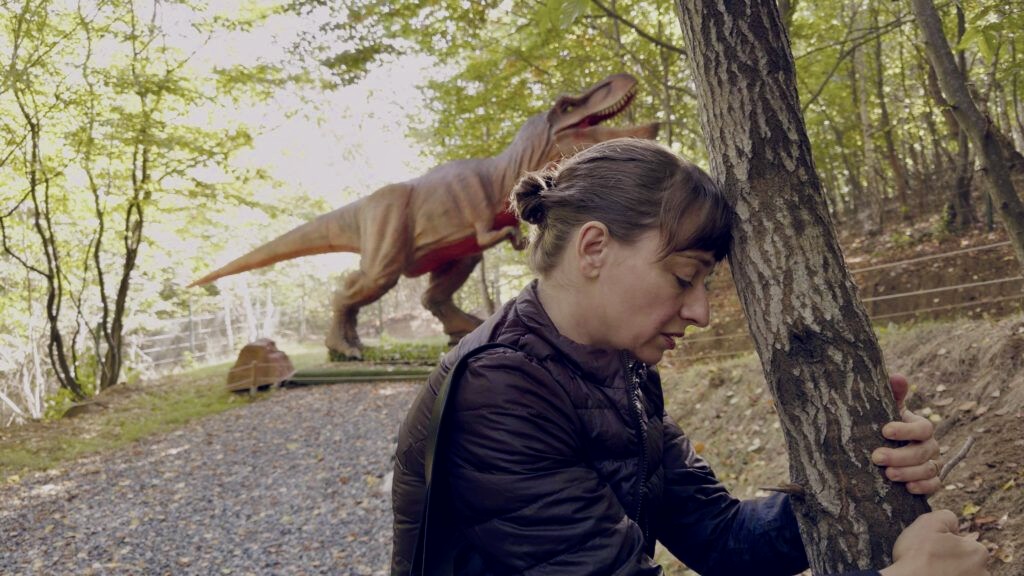
The story follows Orsolya (Eszter Tompa), a bailiff who witnesses a tragic scene at work while carrying out a routine eviction. Shaken by the event and the role she plays in it, she finds herself unable to move on. Her psychological burden, however, is barely acknowledged by those around her, and it’s certainly not understood. For days, she carries this heavy emotional baggage around, taking it to her husband, her mother, a priest, a friend and even to an unlikely acquaintance she bumps into. For the most part they are merely interested in the potential legal implications of her involvement in the affair, and they declare her morally absolved.
By zooming in on the psychological aftermath of a single incident, Kontinental ‘25 reveals the problematic structure of an entire social system. Neither the organisations designed to support the public (such as social services or the police) nor the community itself feel responsible for, or particularly affected by, the hardships of the single citizen. The story is not just a biting commentary on a dysfunctional society, but also an illustration of how trauma has no place in the humdrum of everyday life. Tragedies flow unobserved amidst daily duties and superficial forms of entertainment. Even friends and family are portrayed as well-meaning but ultimately emotionally blunt confidants.
The plot adopts the general premise and thematic template of Rossellini’s classic film Europe ’51 (1952). While the two stories are completely different, they overlap in many ways, such as in their observations on the housing crisis and in showing that the less privileged are invariably isolated. The female protagonists of the two films, Eszter Tompa’s Orsolya and Ingrid Bergman’s Irene, are deeply affected by the suffering that surrounds them, but in both cases it is implied that people find it hard to make sense of empathy unless they try to place it within a pre-existing frame such as that of religion or charity. Empathy without a specific end is met with awkwardness and bemusement.
Rossellini’s story begins with a child who feels neglected by his mother and is overwhelmed by this. In Jude’s film, it is a homeless man – a child of society, one could say – who is abandoned and left to deal with his problems alone. By the end, it’s as if Irene regresses to the state of a helpless child, while Orsolya experiences a feeling of homelessness, albeit metaphorically, just like the character we see wandering aimlessly in the opening scenes (played by Gabriel Spahiu) looking for comfort and shelter.
Kontinental ‘25 encapsulates universal social themes into one woman’s single experience. In spite of the bleak picture depicted, the tone of the film is by no means tragic, as there’s plenty of room for dark humour. The narrative, in and of itself, is not exactly captivating, and perhaps the film lacks dynamism overall. The hint of irony that runs through every scene, however, gives an edge to dialogues and an absurdist twist that keeps things stimulating. Thematically and intellectually compelling, it leaves an impression long after watching.
The Immersive Verdict: Thematically and intellectually compelling, perhaps it lacks dynamism overall but its absurdist twist keeps things stimulating, and it leaves an impression long after watching.
— Mersa Auda