
Running until 8 November 2025
Food may not be considered as consequential as politics or scientific advancements according to history books, but eating habits can reveal a lot about any given population, from their beliefs to their power. Doha’s Museum of Islamic Art presents a captivating exploration of culinary heritage across a large geographical belt that extends from North Africa to the Muslim-dominant countries of South Asia. Divided in five sections, the exhibition delves into the social, medicinal and religious elements that have influenced the consumption of food in these areas over the ages.
The first part is dedicated to bread, which is considered the foundation of eating in many cultures and sometimes a symbol for food itself. A selection of videos shows the diversity of bread-making across countries ranging from Afghanistan to Syria and Egypt. Bread is often synonymous with the idea of hospitality, unity and sharing, but it’s also a staple that is rarely absent from the table. It has an even more prominent role here as it is sometimes used to scoop up food or used as a base that the rest of the meal is laid upon.
Another section is dedicated to the links between food and faith, tracing the story of the birth of Islam and delineating how some foods were branded lawful (halal) or forbidden (haram). As with most religions, some Muslim practices are closely connected to the consumption of food, most famously the observance of Ramadan, a time when worshippers are required to fast from dawn until dusk. Ramadan is followed by Eid al-Fitr, a festivity that lasts up to three days and often involves celebratory meals and social gatherings. At this time there is also the obligation to perform Zakat al-Fitr, which is a charitable donation often done in the form of food to ensure that everyone can eat and thus celebrate the end of the fasting period. Whether one shares it, abstains from it, donates it or wastes it, food has thus come to represent core values and to measure moral conduct.
The history of ingredients is another topic that gives an insight into the evolution of various cuisines. For instance, Baghdad’s sophisticated agricultural systems during the Abbasid period (750–1278) revolutionised the production and spread of crops, while advancements in navigation were equally fruitful for Abbasid merchants who could bring spices such as cinnamon, nutmeg or cloves from the Far East. It was at this time, when new ingredients were prompting the creation of richer dishes, that the earliest surviving cookbook written in Arabic was produced in Baghdad: Kitab al-Tabikh (كتاب الطبيخ; or Book of Dishes). Some ingredients that were exported in later centuries, like aubergines and potatoes, were shunned to start with but gradually became central to Middle Eastern cuisine. Alongside gastronomical advancements, food was used as medicine in a holistic, preventative approach.
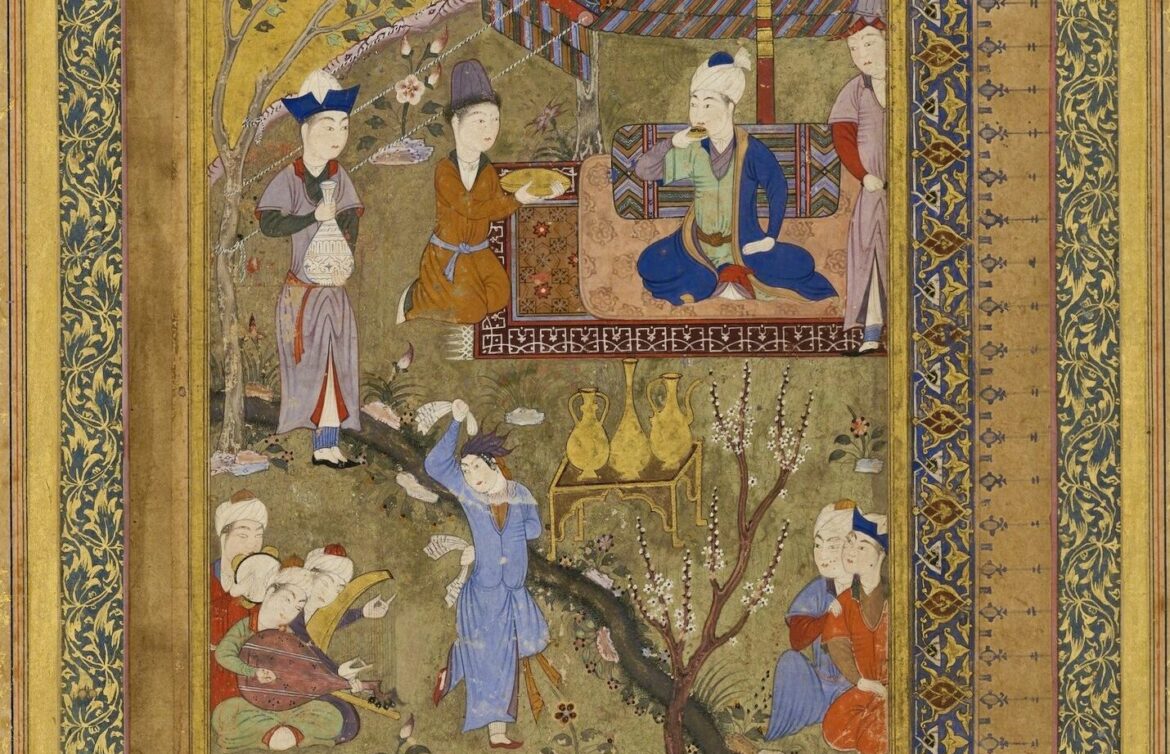
A central part of the exhibition looks at royal banquets and all the artistic objects associated with them, such as tapestries, ceramics and dining utensils. One can admire various artefacts on display such as a 16th century Iznik plate, showcasing Ottoman ceramic artistry, or a 14th century Mamluk brass tray that hints at opulent courtly feasts. Finally, the exhibition offers a reflection on contemporary cuisine, modern agricultural practices and the juxtaposition of fast food culture with the slow food movement.
A Seat at the Table is a multi-sensory journey traversing the social, spiritual, and gastronomic traditions of the Islamic world and it gives one the impression of seeing tales from the past come alive as one walks through it. Whether drawn to art, history or food stories, this exhibition offers a rich experience that speaks both to communal pasts and a future that is fast unfolding amidst innovation and important global debates.
For more information or to book, visit the MIA website here.
— Mersa Auda