Running until 12 April 2026
Before even stopping to think of the specific ways in which Picasso’s world overlaps with the dramatic arts, one instinctively senses that there is a strong link between the two, perhaps because it’s easy to associate Picasso with anything that entails energy and performance.
The first thing that comes to mind is his fascination with matadors and flamenco performers, but there is also a more tangible connection that is less known. For a number of years, Picasso worked on several theatrical productions as a stage set designer. His experience mainly involved collaborations with Sergei Diaghilev’s Ballets Russes, with shows including Parade (1917), Pulcinella (1920) and Cuadro Flamenco (1921). Although it was a secondary endeavour in his career, his work in stage and costume design demonstrates the extent of his keenness to actively explore the performing arts as an insider.
The curators of Theatre Picasso, Enrique Fuenteblanca and contemporary artist Wu Tsang, have approached the theme in a much broader sense. They view Picasso himself as having ‘performed’ his life as a celebrity artist – to the media, to his admirers, to acquaintances. They suggest that he borrowed the tools and methods of the performing arts and used them to “relate to the world around him”. A short video clip showing Picasso playfully impersonating Carmen, filmed by Man Ray, introduces this outlook early on in the exhibition.
The main room is set up as if it were a performing space, and just like in a theatre, most surfaces are black. In one corner there are seats for an audience, facing a screen where the documentary The Mystery of Picasso (by Henri-Georges Clouzot, 1956) is projected. The reel shows Picasso’s work come to life, line by line, using a stop-motion effect. His art in this case is not just a finished product but a performative act.
There is an acknowledgment of the literal link to the theatre through photographs and sketches that document Picasso’s innovative design creations. There’s also a mention of the surrealist play he wrote and directed, Desire Caught by the Tail (1941), which was even translated in English and performed in London in 1950. This material is the most concrete evidence of his close relationship to the theatre, but it is not the focal point here.
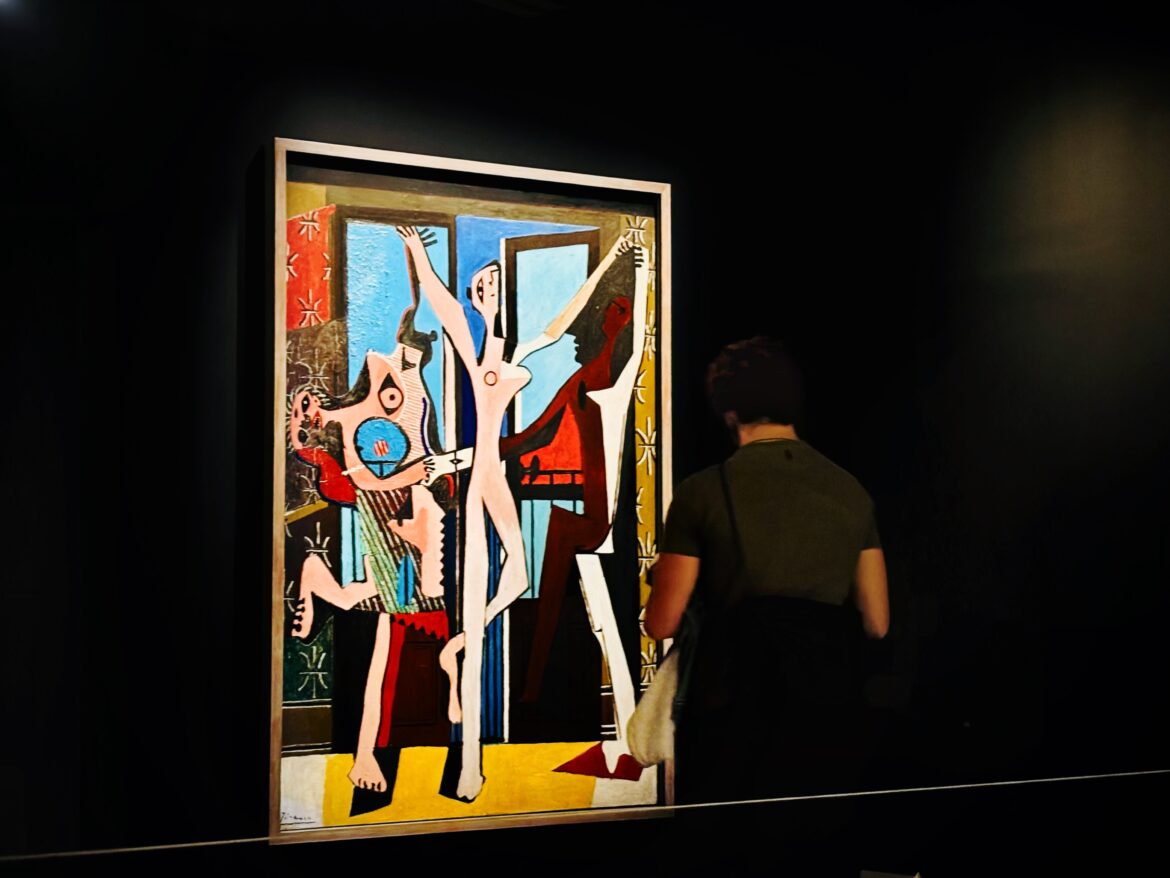
The central piece of the exhibition is The Three Dancers (1925), which represents the artist’s exploration of performance through his default medium – painting. This key work is placed in a corner, facing away from view as one enters. One of the issues with the exhibition is in fact the layout, which is not so harmonious, and the fact that the grouping of paintings is not always congruent. That may be because the exhibition tries to do multiple things at once instead of taking one clear direction.
There’s a section about the women that Picasso depicted in his portraits, and a part dedicated to the anti-colonialist book Lost Body by Aimé Césaire, which Picasso illustrated. While interesting in their own right, these additions seem to answer a completely different need: that of counteracting any potential criticism to Picasso’s less than ideal behaviours, which are being increasingly scrutinised in retrospect.
This preventatively apologetic outlook could have, and perhaps should have, belonged to a different exhibition with a focus on reframing Picasso as a person. As for theatre, which is the central theme in question, it would appear that the curators’ presentation remains vague and scattered. Viewers are required to make their own connections and conclusions regarding the material at hand.
Although the set up is not as intuitive or cohesive as one may hope, Picasso’s work speaks for itself and there is more than enough to impress and inspire.
For more information or to book, visit the Tate Modern website here.
Photo from the press view: Mersa Auda.
— Mersa Auda